

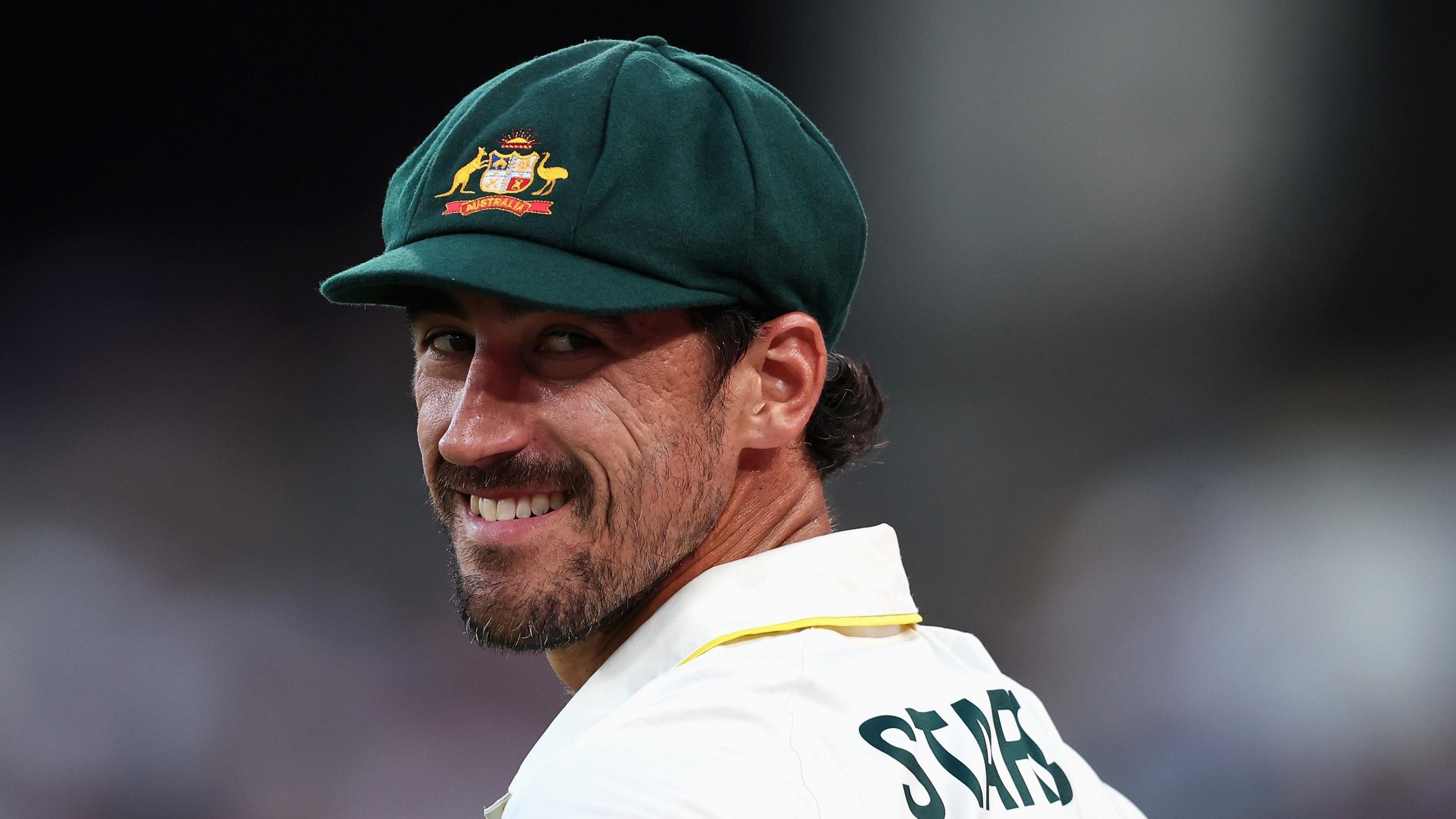
The Australian paceman is the highest wicket collector in the current Ashes series with 26 wickets at an average of 17.42.
The English team's Mitchell problem goes back a considerable period.
It began with the sheer pace of Mitchell Johnson in 2013, and has continued through the magical left-arm pace of Mitchell Starc.
In the seventh Ashes series of his career, Starc has claimed 26 crucial wickets - stepping up in the absence of pace colleagues sometimes more highly rated.
Another four wickets in the final Test in Sydney and his series tally will be the most successful by any bowler in an Ashes series since Johnson 12 years ago.
How 'Toughening Up' Resulted In Many Summers of Starc
The Starc's dominant summer - the 35-year-old has also scored more runs than three of England's top order with the bat - is the peak of a Test career founded on longevity, bowling prowess and a desire to improve.
Over the past six weeks he has overtaken Curtly Ambrose, Harbhajan Singh, Shaun Pollock and, most significantly, the great Wasim Akram on the list of cricket's greatest bowlers.
By surpassing Wasim, Starc became the highest wicket-taking left-arm pace bowler in Test history.
And when he lines up at his home ground for the fifth Test this week, it will be the 27th consecutive Australia Test in a row in which he has featured - a wider run of only four missed Tests from the past 56.
The time of a young Starc being told to "toughen up" by then Australia coach Tim Nielsen are a thing of the past.
"Initially it might have pricked him a little bit and that is likely the role to challenge players and to try and get them to be stronger than they have been in the past," Nielsen said.
"This was likely one of the talks you have with a lot of young fast bowlers, especially when they start to enter international cricket.
"It happened a couple of times where he said he was a bit uncomfortable and might need a break.
"It wasn't anything more than 'I think it's time we have got to discover how much your body can take before it breaks rather than stopping in case it breaks.'"
Why Is Starc So Hard to Face?
Such is the change, the national team's coach Andrew McDonald has raised the possibility of Starc, the oldest of the elite fast-bowling group, playing in England for the next Ashes series in England, by which time he will be 37.
The legendary Ray Lindwall, who played his final Test in 1960, was the most recent Australian fast bowler to wear a Test cap beyond his 37th birthday.
Achieving this would give Starc the chance to join James Anderson, Stuart Broad, Glenn McGrath and Courtney Walsh and become only the fifth pace bowler to take 500 Test wickets.
Durability can get you only part of the way. To join that club, you must be a constant danger too.
"Paradoxically, even though he is so brilliant, is that at the top of his mark you can see what he is planning to bowl," says former England batter Dawid Malan.
"You still have to be able to play it but you can observe when he is preparing a seam delivery, see when he is attempting to swing the ball."
Periodically in Starc's career when he has been faulted for being expensive, something with which he has said he has made peace.
That weakness is massively outweighed by his remarkable skill to take wickets.
Of the top-tier bowlers to have taken more than 350 wickets in Tests, only two modern greats have done so with a more frequent wicket-taking rate than Starc's.
He may go for runs, but the mean number of balls he needs to take a wicket is remarkably low.
"The difficult aspect is I always felt like I was comfortable facing him," Malan explained.
"I felt I was seeing the ball well because he has such a fluid action, you can track the delivery and there are excellent batting surfaces in Australia but periodically he'd bowl an unplayable delivery and you would just be walking back.
"In between that, I wouldn't say you relax but you think 'I'm on top here.'
"He will bowl a half volley because he has searched for something, bowl a slower ball and then abruptly bowls a ball that starts on middle and hits the off stump.
"He has just always got that lethal ball. If you don't respect him every single ball he just finds a way of taking your wicket."
A New Peak Powered By New Tricks
While he may not reach the 99mph heights of his early career these days, Starc's average pace has remained solidly above 87 miles per hour throughout the most recent phase of his career.
An skill he held from the outset shows no indication of declining.
"He was tall, proper tall, and had exceptional pace through the air which was remarkable," Nielsen says.
"Additionally, he could swing the ball back into the right-handed batsman."
Swinging the ball and crashing into the toes, pads or grille was, like other great left-armers before him, Starc's key strategy during the early years of his career.
But, after being dropped during the 2019 Ashes tour, Starc mastered the wobble seam delivery to his armoury by the time he came back to England in 2023.
No-one in the world has taken as many as Starc's 118 wickets since the beginning of that 2023 series. Even Indian pace ace Jasprit Bumrah is behind by 12.
The wobble seam has been a primary cause.
"Starc just shows you can teach an old job new tricks," stated former Australia pace bowler Jason Gillespie.
"He studied a lot of Stuart Broad and James Anderson and spoke to them about it.
"For an athlete aged his mid-thirties to stride and get better is fantastic."
The wobbler has introduced greater uncertainty to Starc's game.
When delivering the ball with a wobbling seam rather than looking to swing it, some deliveries move off the seam off the surface after pitching. Others will go on with the arm and bring in the outside edge.
Zak Crawley and Joe Root both fell to Starc wobble seam deliveries in the first session of the current Ashes.
Starc's number of catches to the slip cordon has jumped by almost ten percent in the past few years.
"The crucial element to the wobble seam is to have your wrist position right aligned with the ball and let go of the ball off your middle finger," Gillespie said.
"For this delivery Mitchell Starc will hold the ball with the seam angled towards the off side.
"Upon release at the correct moment it will wobble its way down the pitch and that creates doubt for the batsman.
"He has working hard at perfecting this because he feels that the wobble ball going across involves the slip fielders into play and makes his in-swinging delivery to the right hander more of a shock weapon."
England's torment by bowlers named Mitchell may continue longer than you think.
